Affiliate Disclosure: Spawnproof is reader-supported. If you buy through links on this page, we may earn a small commission at no extra cost to you. We only recommend gear we've actually put through real use.
I spent a decade on warehouse floors before I ever thought hard about a chair — you don't think about your feet until they're wrecked. Then I moved into ops, sat down for the first time in years, and found out fast that a bad chair does to your lower back in six months what standing all day does in five. I'm 6'1", right around 210 lbs, and the first time it really caught up with me was a Saturday spent laying out a new base in Valheim — I stood up four hours later and my hips told me exactly what they thought of that decision.
That's what sent me looking at the SIHOO M18, and it's the chair I've had under me for every session since. Build what keeps you alive first — that rule doesn't stop applying just because you left the game world.

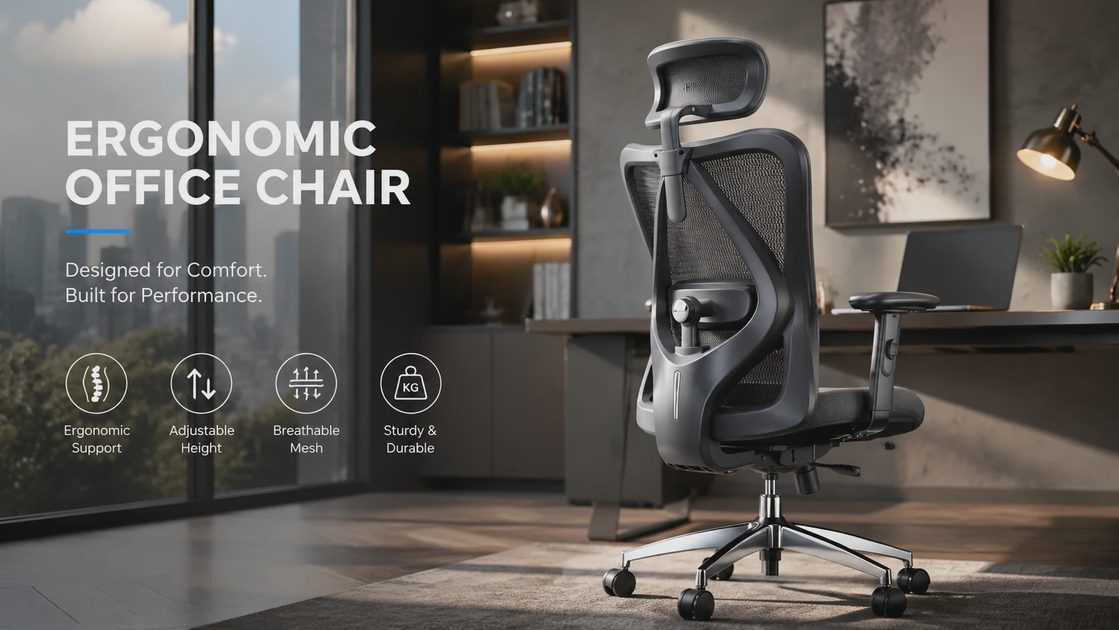
The SIHOO M18 — high-back mesh frame with adjustable headrest.
→ Check Today's Price on Amazon
Not a Gaming Chair — And That's the Point
Every "gaming chair" I owned before this one was built to look like a race-car seat: bucket shape, PU leather, RGB piping down the sides. Great in a thumbnail. Rough for a six-hour base build, because leather traps heat and a foam bucket stops holding its shape somewhere around month three. The M18 doesn't dress up as a gaming chair — it's an ergonomic office chair that happens to outlast anything actually marketed at gamers, and for long survival-crafting or strategy sessions, that's the only category that matters. RGB and race-seat styling: that's a luxury item, not a survival item.
What Actually Matters Here (Not What's On the Box)
Most chair listings bury the two or three things that actually decide whether you'll still like the chair in month six under a pile of marketing words. Here's the short list, ranked the way I'd rank it for a first-night priority list.
Lumbar support that moves — up/down and in/out — so it lands on your actual spine, not wherever the factory guessed.
A seat with a waterfall front edge, so the cushion doesn't cut into the back of your thighs on hour three.
Armrests that adjust for height, so your shoulders aren't doing the work your desk should be doing.
A weight rating with a real certification behind it, not just a number on a spec sheet.
Feature | Detail |
Back Material | Breathable elastic mesh, high-back |
Seat Cushion | W-shaped high-density foam, waterfall front edge, 53cm wide |
Lumbar Support | Dual-adjustable — height + depth |
Headrest | Height and angle adjustable |
Armrests | 2D, height-adjustable (limited width movement per owner reports) |
Recline | Multi-angle lock, ~36° tilt range, adjustable tension |
Gas Lift | Steel, SGS/BIFMA certified, 3.15" lift range |
Base | 70cm diameter, quiet-roll PU casters |
Weight Capacity | 330 lbs, BIFMA-tested to 1,136kg static load |
Seat Height Range | 43–53cm |
Total Height Range | 109–130cm |
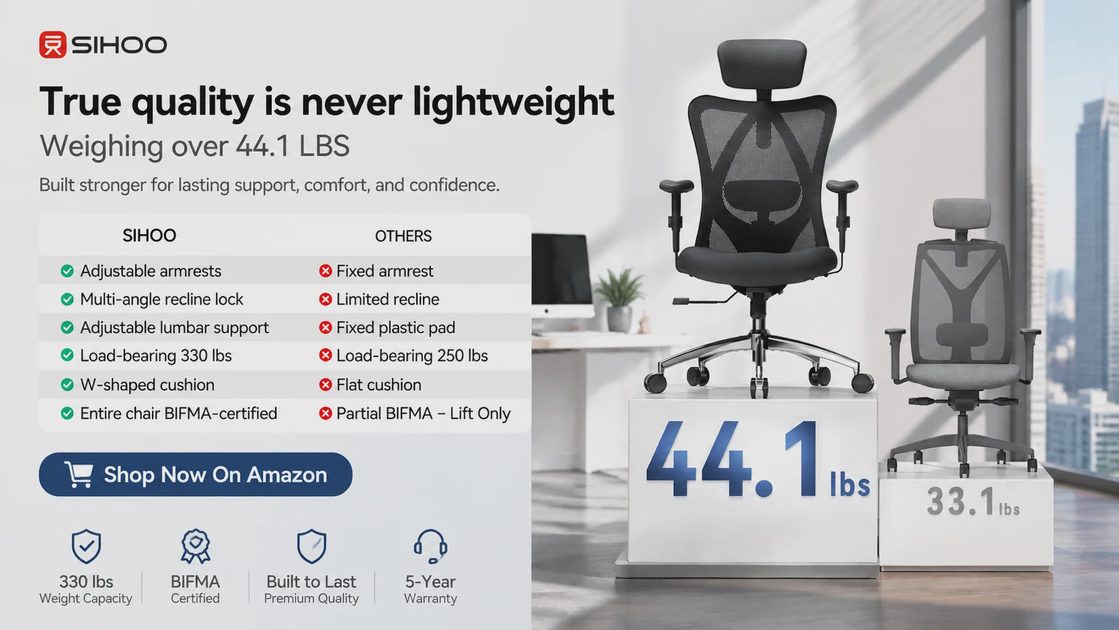
Chair Weight | 44.1 lbs |
Assembly | ~25–40 minutes, tools included |
Warranty & Returns | 30-day returns + 3-year replacement-parts coverage |
Typical Price | $160–$200 (fluctuates with deals) |
Built to Actually Take a Beating
The parts that fail first on a cheap chair are the ones you never see: the gas lift, the base, the tilt mechanism. This is the one place I don't cut corners on gear, gaming or otherwise — a $30 part failing under you at 2 a.m. is not a hypothetical, it's a Tuesday.
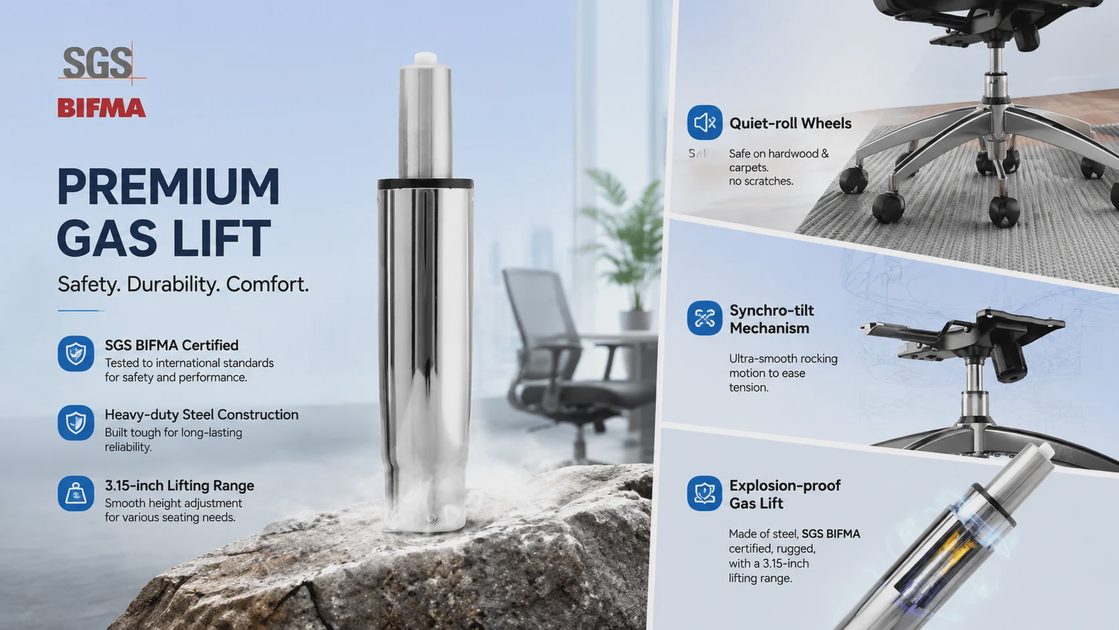
Steel gas lift, quiet-roll casters, and the synchro-tilt base underneath the seat.
→ Check Today's Price on Amazon
The gas lift is steel and SGS/BIFMA rated, the casters are the quiet-roll type that won't chew up hardwood, and the tilt mechanism is a synchro-tilt setup — the seat and back move together instead of fighting each other when you lean back mid-raid. At 44.1 lbs, this frame is noticeably heavier than the sub-35-lb chairs in the same price bracket, which lines up with what I felt sitting in it — it doesn't rock or flex under normal movement.
The Hard Lessons Part — What I'd Tell You Straight
I don't sell hype, and I'm not going to start with a chair. Reading through a wide spread of owner feedback alongside my own time in it, here's what's worth knowing before you buy.
The seat is firm, not plush. Closer to a dense board than a sink-in cushion for the first week. I prefer that — firm holds its shape better over a six-hour stretch than foam that compresses. If you're coming from an overstuffed chair, give it a week before you judge it; a share of owners never made peace with the firmness.
The lumbar pad can feel like a brick — if you skip adjusting it. It's contoured plastic wrapped in mesh, not a soft pillow, and if you don't take five minutes to dial in the height and depth, it lands in the wrong spot on your spine. Adjusted correctly it disappears; unadjusted, it's the single most common complaint I found in the negative reviews.
"Big and tall" is optimistic. The armrests sit about 20" apart, which is comfortable for most builds but tight if you're broad-shouldered or over 6'3". Measure before you buy — this isn't a wide-body chair.
Plastic parts are the long-term wear point. A share of owners reported the lumbar knob or armrest padding loosening after a year-plus of daily use, usually under heavier daily loads. SIHOO's replacement-parts coverage came up repeatedly as fast to resolve when that happened.
None of that is a dealbreaker for a $180 chair — it's the trade-off against $700 chairs that don't have these problems. Know it going in and you won't be annoyed by it later.
Who This Actually Fits
Buy it if:
You're doing 3+ hour survival-crafting or strategy sessions and your current chair is the actual bottleneck.
You run warm and you're done with the sweaty-back feeling from PU leather bucket seats.
You want a certified 330 lb frame without paying into the $500-plus tier.
You're roughly 5'6"–6'2" and under 330 lbs — the seat and height range cover most desks without a riser
Don't buy it if:
You're over 6'3" or broad enough that a 20" gap between armrests will feel tight.
You want a soft, sink-in seat instead of firm support.
You care more about RGB and race-seat styling than function.
You won't spend five minutes actually adjusting the lumbar before judging it.
The Price Math
The M18 lists around $200–$290, but it spends most of its life discounted into the $160–$200 range — less than half of what a lot of racing-style gaming chairs run, and well below the $500-plus tier where you'd normally find dual-adjustable lumbar and a certified 330 lb frame. Spread over the years you'll actually sit in it, that's roughly the cost of one new release a month. Prices move with deals, so check the live number before you decide.
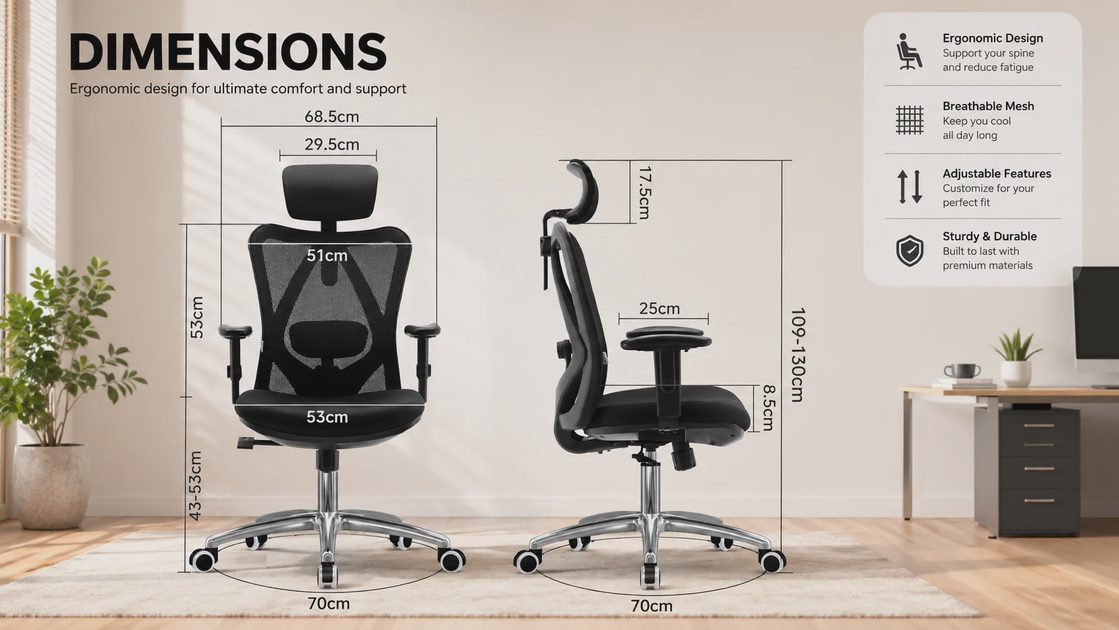
Full dimensions: 43–53cm seat height, 109–130cm total height range, 70cm base.
Same rule as always: build what keeps you alive first — and for most of us, that starts with the seat, not the setup.
→ Check Today's Price on Amazon
FAQ
Q: How long does assembly take, and do I need a second person?
A: Budget 25–40 minutes solo. The one step that goes faster with a second set of hands is mounting the backrest to the seat frame — it's not heavy, just awkward to hold and screw in at the same time alone.
Q: How does the replacement-parts warranty actually work?
A: If something arrives damaged or a part fails under normal use, you contact SIHOO support with your order number and a couple of photos. Several owners reported a reply within a day or two and a replacement part shipped out — no need to return the whole chair.
Q: Does the mesh need any special cleaning?
A: No — a damp cloth and mild soap handles the mesh back and fabric seat. Avoid harsh solvents on the plastic frame, and wipe the gas lift shaft occasionally if dust starts affecting the height adjustment.
Q: What colors are available?
A: Beyond black, the M18 line comes in options like grey, white, blue, green, and pink depending on current stock — availability shifts, so check the listing for what's currently in rotation.
Q: Does it recline all the way flat?
A: No — this is a task-chair recline, locking at multiple angles for reading or resting, not a zero-gravity lay-flat. If you want fully horizontal, you'd need a chair built around a legrest and a much deeper recline range.
Q: Is it noisy when I lean back or roll around?
A: The casters are the quiet-roll type and stay silent on both hardwood and carpet. A small number of owners reported a brief creak from the tilt mechanism in the first week that settled in with regular use — not something that showed up consistently across reports.
No letters yet.